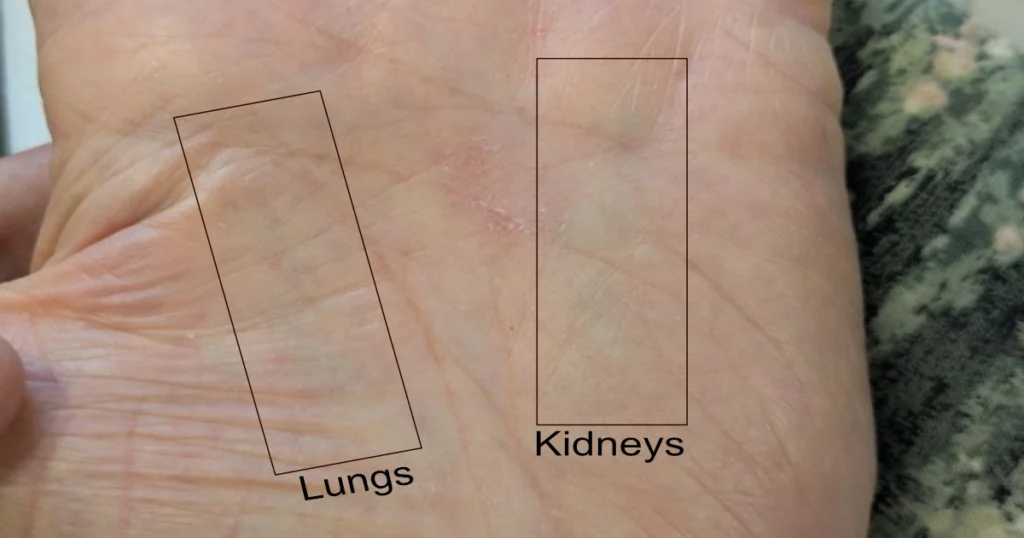

Master Tung left behind two lists that most practitioners never use. One of these is the seventy-two Severing Points, and the other is Master Tung’s 32 Relieving Points—of which he only ever showed eighteen. Since they are not categories most practitioners reach for, they are worth discussing precisely because a case may arise that calls for them. Such a case did: a woman who had been unable to get rid of what she had inhaled over four days. This case also clearly shows how I proceed—first using the VAS for the palm diagnosis, then for selecting the points, and only after that do I write down the reasoning.
Master Tung’s 32 Relieving Points
The Dong shi san shi er jie zhen [董氏三十二解針] points are included under the character Jie [解]. This character has several meanings: to divide, separate, dissolve, free, remove, release, open, and explain. All of these meanings are relevant in the context of treatment. A Relieving point is not a strengthening point, nor is it a moving point; it helps the body let go of what it is holding onto.
Their traditional applications address sudden illnesses caused by toxins from external sources—for example, food, medicine, drugs, alcohol, bites, or fumes—and the sudden dizziness, fainting, and pain that follow. The most widely known acupuncture point, 22.10 Shou Jie [手解], is the one that all practitioners learn in order to deal with shock resulting from needles, pain and a sensation of tightness after acupuncture, and with sharp pain following a bruise; it is based on the same principle but applies it to minor injuries.
Master Tung did not give the full list; the eighteen points which he did make known are set out below together with the seventy-two Severing points: Tung’s 72 Severing (Absolute) and 32 Relieving points. The pair important in this case appears on that list—DT.01 and DT.02, Fen Zhi Shang [分枝上] and Fen Zhi Xia [分枝下], Divided Branch Superior and Inferior.
How I work, before the case itself
I should state this at the beginning; otherwise, the rest of the article would make no sense.
I apply the VAS – the Vascular Autonomic Signal – in two stages: first to diagnose by examining the palm and then to select the points.
For those who are not familiar with it, the VAS involves a noticeable alteration in the way the radial pulse feels, appearing within a few heartbeats of a stimulus having been applied somewhere else on the body; it enables you to ask a question of a particular point before inserting any needle and then obtain the answer from the pulse.
That means I don’t select points by first thinking about them and then verifying them. Instead, I look at the body and let it show me the points, and only then do I consider why.
Presentation
On 21 August 2026, a woman came for consultation. Four days earlier, workers had been applying contact adhesive at the kindergarten to prepare the room for the following year, and the woman was in the building when they did this and inhaled the fumes.
Dizziness and nausea started almost at once, accompanied by a tingling sensation all over the body. She took an anti-nausea tablet, which relieved the nausea and lessened the dizziness, although some dizziness remained.
The reason for her seeking treatment was a restlessness that affected her entire body—nothing to do with worrying about being exposed, but rather a physical discomfort that she could not remain still while experiencing. She said she felt a burning inside and a pulsing all over, not just in the chest. She had not slept for two nights.
It is a common pattern: the sudden and obvious symptoms caused by exposure to a solvent have been eased by the medicine, leaving behind the aspects that the tablet couldn’t affect—namely, the heat that had entered the body, a Shen that would not settle down, and the body’s continued attachment to something it could not get rid of.
Examination: the palm gives the root
I used the VAS to read the palm, and it identified three areas.
On the left: Liver and the Lung.
On the right: Heart.
The information the palm gives me relates to the underlying cause; anything shown there is part of the root—the hand isn’t displaying the symptoms themselves, but what lies beneath them. Once I establish that, I can examine the symptoms. I start with the root and then consider the branches.
In this case, the root cause and the source of the problem were identical: the lung shows the point of entry—the harmful substance entered through breathing, so the lung was the first to be affected—and the liver was the organ that then attempted to eliminate the toxin.
On the other hand, the Heart is also part of the root; it is the organ responsible for the pulsing she felt all over her body and the restlessness.
The palm did not say she had inhaled a solvent; she had already told us that. It informed us that the exposure was still not cleared and which organs were still affected on day four. Otherwise, her symptoms would have been three complaints without a clear diagnosis.
Treatment
First, bleeding, affecting both DT.01 and DT.02.
The point DT.01 Fen Zhi Shang [分枝上] is situated approximately one cun below the acromion, while DT.02 Fen Zhi Xia [分枝下] is about 1.5 cun below that and 0.5 cun towards the middle from it. Traditionally, these points are used in the treatment of cases of food poisoning, drug poisoning, and gas poisoning. When the poisoning is entirely due to an inhaled toxin, these points are not merely one of several possible choices; they are the correct points, and the order of use matters—the toxin should be removed first, then the body regulated.
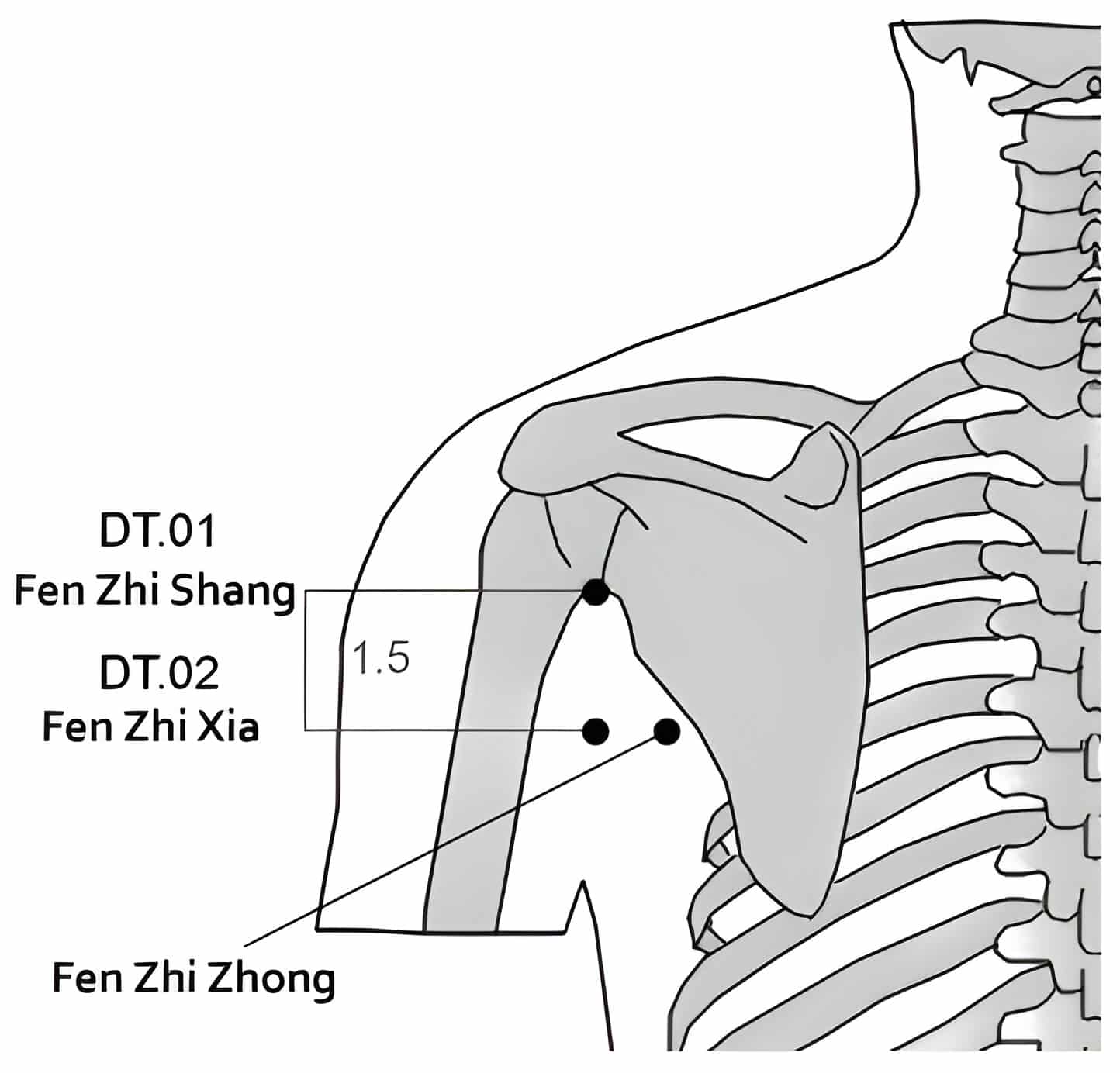
I extracted blood from both of the points on both sides. When a patient presents as restless and unable to sleep, there is a natural tendency to provide an immediately calming treatment. But her restlessness was not due to a Shen disorder that had arisen spontaneously; it was caused by the fact that something was still in her body which ought not to be there. It would be like treating the smoke without first addressing its cause.
First, needle the root points.
In acupuncture carried out by Master Tung, the primary points used to treat the root are in the 88 and 77 areas—the thigh and lower leg—and treatment begins there. Once you treat the root, you move to other points that address symptoms elsewhere on the body. Following this simple sequence keeps the treatment clear and effective.
The organ points are needled at the side of the palm where the VAS was detected — of course, only after confirming that the points are active and give off a VAS themselves.
Left side — the Liver and Lung:
- Si Ma [駟馬], 88.17 to 88.19. This is the Lung group.
- Shang San Huang [上三黃], 88.12 to 88.14. This is the Liver group.
- 77.18 Shen Guan [腎關] — when tested with the VAS, it is found to be active. It is a key point for strengthening the Kidneys, particularly Kidney Yang; this is why it is appropriate in a case such as this rather than merely serving as a general tonic, since expelling a pathogen requires energy, and the Yang supplies that energy. The rest of the treatment provides a means of escape. This point provides the strength needed to use that means.
Right side — the Heart:
- The Heart group, Zu San Tong [足三通], 88.01–88.03.
Then the symptomatic points.
Once the root is addressed, the rest of the prescription deals with what she was really feeling. A habit I have here is to begin with the points related to the root when I am looking for symptomatic points; by ‘looking,’ I mean using the VAS.
- The acupoints specified are 66.10, 66.11, and 66.12—Huo Lian [火連], Huo Ju [火菊], and Huo San [火散]—on the medial aspect of the right foot. This set of points is used for treating dizziness accompanied by palpitations, and it also addresses insomnia—thus dealing with three out of the four complaints she has. These points have a reaction area of the heart, so they also correspond to the root.
- 22.04 Da Bai [大白] left.
- Zhong Kui [中魁], on the left, is located on the back of the middle finger.
I emphasized the last two points because they relate to the Lung and because the VAS showed them to be active. That is the entire reason, and I want to state it clearly rather than conceal it: they were actually active and belong to the organ which suffered the injury first.
For the left ear: the allergy point, the sympathetic point, and the Zero point. The sympathetic point and the Zero point address the autonomic overdrive that causes whole-body pulsing and restlessness; the allergy point addresses the reactive aspect of chemical exposure.
Response
She said that she felt some relief during the session.
One day later, she sent me a WhatsApp message. She feels much better and had a full night’s sleep; the pulsation all over her body disappeared.
Learn the method
Palm diagnosis, the Vascular Autonomic Signal, and bloodletting therapy work best when learned through hands-on practice on an actual patient rather than by reading about them, and I will be teaching them over three days in Madrid from 30 October to 1 November 2026 at the Leonardo Hotel Madrid City Center with English lessons and Spanish translation.
Day one covers bloodletting therapy—foundations, mechanisms, sterilization and safety, and clinical application —including points such as the pair used in this case. Day two covers palm diagnosis and the VAS. Day three is clinical integration, with live patient demonstrations and supervised practice in small groups.
Full program and registration.
Patient details have been anonymized. This case describes one patient’s course after a single treatment and is not a claim about treating chemical exposure in general. Acute inhalation exposure can be serious; anyone with ongoing symptoms after a chemical exposure should be assessed medically.