

Presentation
An 82-year-old man was referred with left-sided renal insufficiency, most probably secondary to an obstruction at the renal outflow. Creatinine at first presentation was 1.54.
It is worth stating the therapeutic goal plainly at the outset, because it governs everything that follows. At this age, with a structural obstruction in the background, the aim was not restoration of renal function. The aim was to slow the trajectory — to keep the picture stable and prevent deterioration.
Examination: reading the palm using Master Tung palm diagnosis
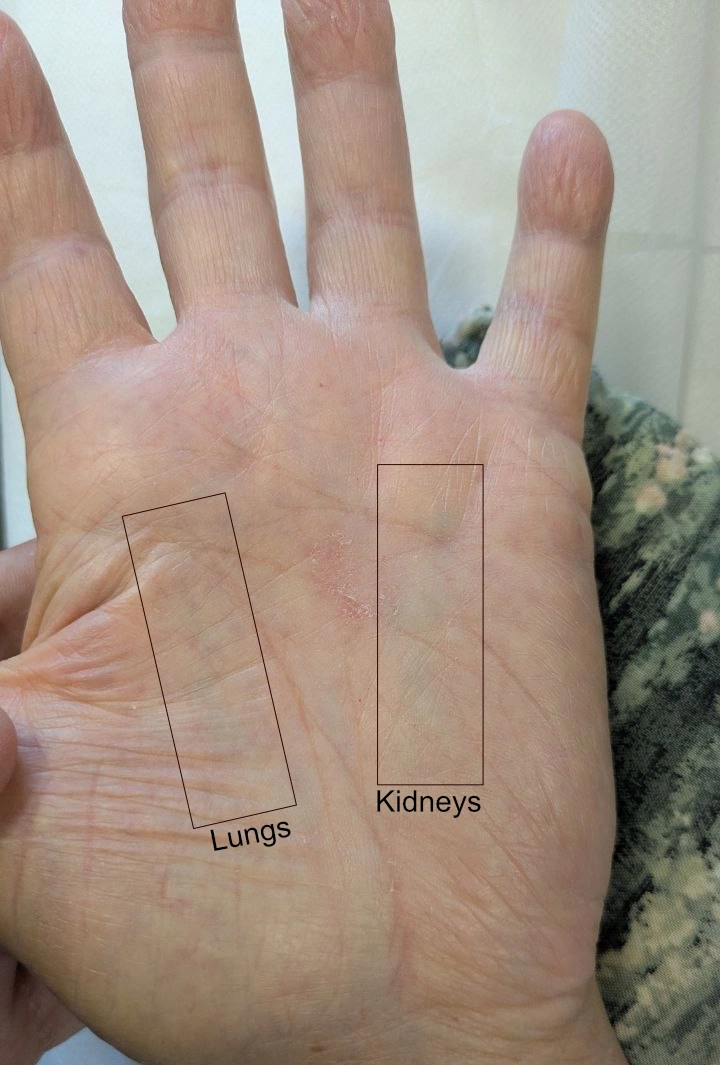
I began with palm diagnosis. In this system the palm is read as a topographic map of the organs, with each Zang and Fu occupying a defined territory. The lines projected from the base of each finger down into the body of the palm carry particular correspondences, and the vascular picture within a zone — congestion, dilated superficial vessels, discoloration, changes in the local skin — is read as information about the organ that zone represents.
On this patient’s left hand, two zones stood out.
The Kidney zone, on the line running from the fifth finger down into the palm, showed congested vessels. Given the referral this was expected, and finding it was confirmation rather than discovery.
The Lung zone, on the line running from the second finger down into the palm, showed the same picture. This was the finding that shaped the treatment.
The principle: bring the Lung qi down to the Kidney
Two organs appearing on one palm can be read in two ways. The weaker reading treats it as two problems and assembles a prescription for each. The stronger reading asks what relationship binds them — and between the Lung and the Kidney, classical medicine gives us a well-worn answer.
The Lung is the upper source of water — 肺為水之上源. It governs the descent and dissemination of fluids, and everything that reaches the Kidney passes through that descent first. Metal generates Water, 金水相生, so the Lung is also the mother of the Kidney in the generating cycle. And the relationship runs in both directions: the Kidney grasps the qi that the Lung sends down, 腎主納氣, so a failure of descent above and a failure of reception below are two ends of a single mechanism.
Read that way, the palm was not showing me two organs in trouble. It was showing me one axis in trouble, at both of its ends. The treatment principle follows directly: rather than treating Lung and Kidney as separate targets, help the Lung qi descend to the Kidney and support the Kidney’s capacity to receive it.
This is the part of the method I most want practitioners to take seriously. The diagnostic finding did not hand me a point prescription. It handed me a relationship, and the relationship dictated the strategy. Points came afterwards.
Point selection: VAS as the arbiter
The Vascular Autonomic Signal was used throughout to determine where to needle. For readers unfamiliar with it: the VAS is a palpable change in the quality of the radial pulse that occurs within a few heartbeats of a stimulus applied elsewhere on the body. Used systematically, it allows a point to be interrogated before a needle is inserted — the practitioner asks the body a question and reads the answer at the wrist.
What it offers in a case like this is validation in real time, on this patient, today. It does not replace knowing the point system. It tells you which part of the point system this particular patient is currently prepared to use.
For the Lung, left side: Si Ma — 88.17, 88.18, 88.19. These are the most important Lung points in Master Tung’s system, and here the VAS confirmed all three. The chart and the patient agreed.
For the Kidney, left side: Xia San Huang (77.17, 77.19, 77.21) came up active on examination. But the Kidney line on the thigh was live along its whole length rather than at three discrete, nameable points — so that is where the needles went: San Tong Shen, 88.09–88.11, and continuing along the same line, San Jie Mei, 88.04–88.06. Six points.
Every point was needled on the left — the same side as the palm findings, and the same side as the affected kidney
Course and outcome
Over the treatment series, creatinine came down from 1.54 to 1.3 and has held there since. From that point on the work has been maintenance: the patient continues to be seen to keep the picture stable and prevent deterioration.
Two honest qualifications belong here. The first is that I am reporting a sequence, not demonstrating a mechanism — a single case with no control cannot separate treatment effect from natural variation, and no practitioner should pretend otherwise. The second is that in geriatric renal care with a structural obstruction in the background, stability over time is itself the outcome being sought. Holding a line is not a lesser result than moving one. It is the result that was aimed at.
Discussion: what this case teaches
The chart tells you where to look; the signal tells you where to needle. Xia San Huang are three named points with a defined location and a well-established indication. On this patient they were active — and they were also an incomplete description of what was active. Had I needled the three points and stopped, I would have been treating the textbook rather than the man in front of me. The VAS gave me a segment; I needled the segment.
This happens more often than the literature suggests, and it is a hard habit to break. Point charts are memorised, and memorised things are reassuring. But the chart is a record of what has generally been found useful, not a description of what is live in a given body on a given morning. When the two disagree, the honest practitioner follows the body.
Diagnosis precedes strategy, and strategy precedes points. The palm gave me two organs. Classical physiology turned two organs into one axis. Only then did point selection begin, and by that stage the question was narrow enough to answer well. Practitioners who move directly from finding to prescription skip the step where the actual thinking happens.
The palm reports on the interior. The Lung finding was not predicted by the referral, the presenting complaint, or anything the patient reported. It came from the hand. In a case where the biomedical picture was already known and the diagnosis was not in question, the palm still contributed something the file did not contain — and that contribution changed the treatment.
Learn the method
Palm diagnosis and the VAS are both teachable, and both are best learned with hands on a real wrist rather than from a page. I teach them, together with bloodletting therapy, over three days in Madrid: 30 October – 1 November 2026, at the Leonardo Hotel Madrid City Center, in English with Spanish translation.
Day one covers bloodletting therapy — foundations, mechanisms, sterilisation and safety, and clinical application. Day two covers palm diagnosis and the VAS, including the approach used in this case. Day three is clinical integration, with live patient demonstrations and supervised practice in small groups.
Early bird registration is €550 until 31 August, €650 thereafter. Full programme and registration.