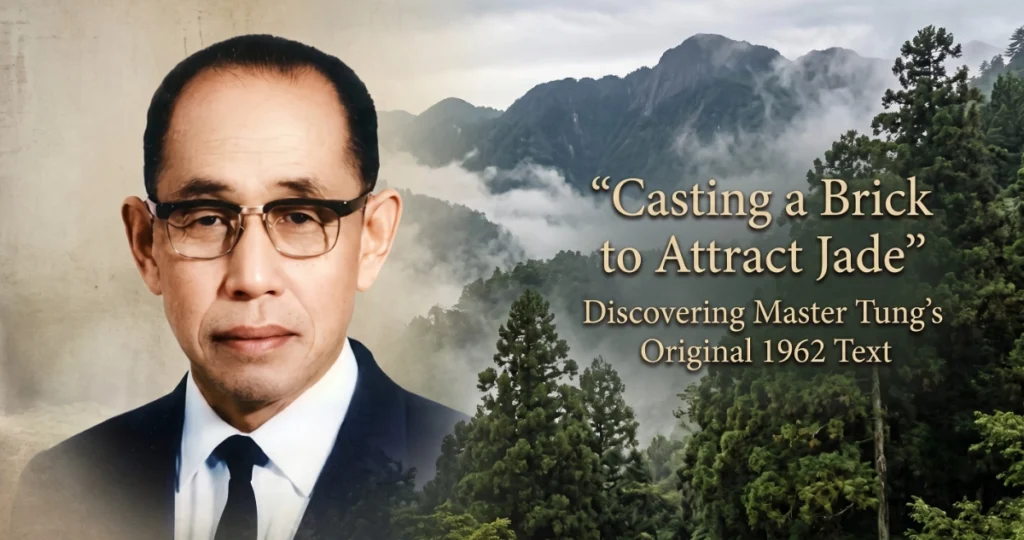

In 1971, the medical world witnessed the legendary Master Tung treatment of Lon Nol, the Prime Minister of Cambodia, who had suffered a devastating stroke that left him with hemiplegia (one-sided paralysis). After months of unsuccessful Western medical treatment in the United States and consultations with various acupuncturists and top specialists across Thailand, Hong Kong, and Taiwan, his condition remained entirely unchanged.
The incredible details of what happened next are not merely legends; they are meticulously documented historical facts.
The Source: Documenting the Master Tung treatment of Lon Nol
The definitive account of this clinical milestone is preserved in the Master Tung’s Acupuncture Research Institute Memorial Book [董公針灸研究所紀念冊], published in April 1977.
Compiled and edited by Master Tung’s dedicated disciple, Yuan Guo-Ben [袁國本], shortly after the Master’s passing in 1975, this book was created to commemorate his life and global impact. Beyond recording specific treatments, it contains rare photographs, eulogies from his students, and photographic evidence of his international honors. It serves as a rare primary source, proving the high level of official recognition his clinical results earned on a global stage.
According to this memorial book, here is exactly how Master Tung restored a nation’s leader.
The First Trip: The Master Tung treatment of Lon Nol
When the Master Tung treatment of Lon Nol officially began on November 3, 1971, the Master was accompanied by his student, Chi Ji [池璂]. He administered acupuncture treatments to Lon Nol for 22 consecutive days.
The results were immediate. After only two days of treatment, Lon Nol experienced a sensation he hadn’t felt in nearly a year. He told his Vice President:
“For eight months, I didn’t know I had a left leg, and today I am aware of it!”
The Second Trip and Presidential Appointment (March–April 1972)
Master Tung was invited back for a second time in March 1972, this time accompanied by his student, Xiao Jie-Wen (蕭傑文). During this 23-day course of treatment, the recovery was so successful that President Lon Nol officially appointed Master Tung as his personal acupuncture physician.
By the presidential election in June of that year, Lon Nol had recovered enough physical strength to walk to the polling station to cast his vote—a powerful symbol of his recovery to the Cambodian people.
Sustaining the President’s Strength
Between 1971 and 1974, the Master Tung treatment of Lon Nol continued across a total of five diplomatic trips to Cambodia. President Lon Nol developed such immense trust in Master Tung’s abilities that whenever he faced major political activities and feared he might lack the physical stamina to endure them, he would send a telegram requesting Master Tung to come to Phnom Penh to be on standby.
Tokens of Appreciation and National Honors
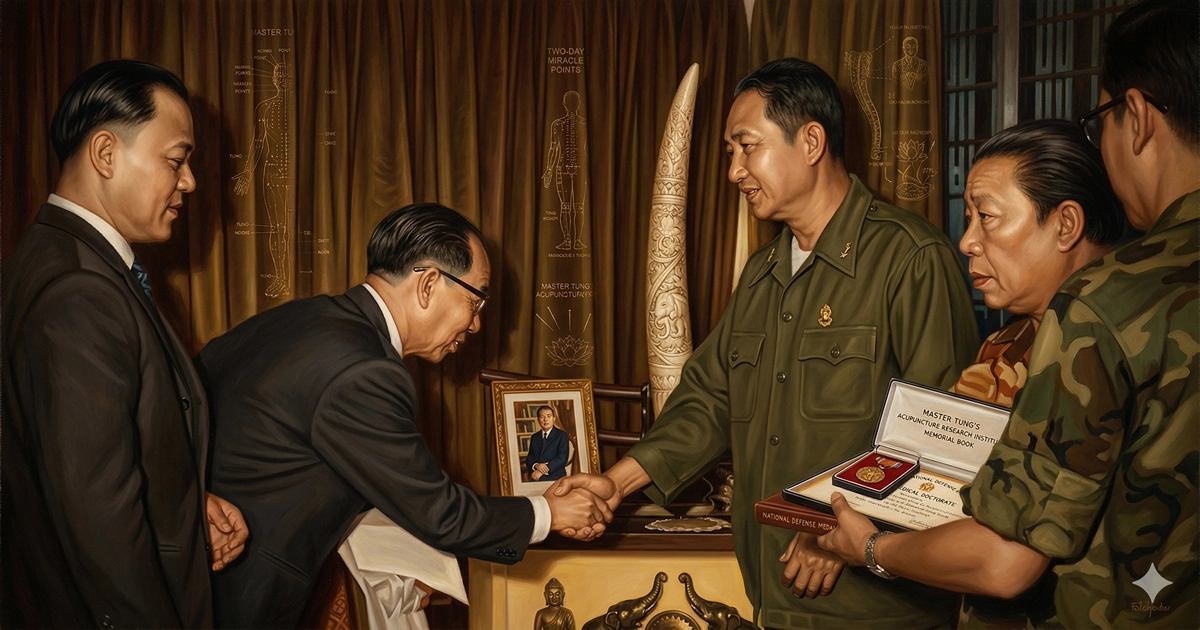
To express his deep gratitude for the successful recovery, President Lon Nol honored Master Tung with rewards rarely bestowed upon a civilian practitioner:
- An Honorary “Medical Doctorate” degree.
- A “Military-grade National Defense Medal.”
- A reward of $10,000 USD.
- Personal Gifts: Three bronze Buddha statues and a large, intricately carved elephant ivory tusk.
This clinical diary: Master Tung’s Treatment of President Lon Nol (1971)
This clinical diary is based on the meticulously preserved records of Master Tung’s 1971 treatments for President Lon Nol. The data was originally documented by Dr. Chen Du-Ren, the student who recorded the clinical cases for Master Tung.
Source and Historical Context
In 2008, Yuan Guo-Ben entrusted these original manuscripts to Dr. Chuan-Min Wang (王全民) to ensure their publication and preservation for the acupuncture community. These records were presented by Dr. Wang on October 10, 2008, at Dr. Wei-Chieh Young’s Advanced Tung’s Acupuncture Seminar.
Primary References:
- Document: Tung’s Acupuncture Case Study [董氏針灸醫案彙報], archived via
ctcwri.idv.tw. - Secondary Source: Ching-Chang’s Points & Clinical Cases, based on the records of Dr. Chen Du-Ren.
President Lon Nol’s Letter of Gratitude
To Master Tung Ching-Chang,
“I would like to express my deepest gratitude for your exceptional medical care. After suffering from the effects of a stroke for many months, the progress I have experienced under your treatment has been remarkable. Your mastery of acupuncture has not only restored movement to my limbs but has also brought joy and hope back to my life. The results witnessed by those around me are a testament to the profound power of your methods.”
Historical Insight: The Birth of “Dao Ma”
Did you know that Master Tung did not actually use the term “Dao Ma” in his official 1973 textbook? In his published manual, he originally referred to his signature multi-needle technique as “Hui Mai“.
This is what makes the 1971 Lon Nol clinical diary so incredibly significant for Tung practitioners. The entry recorded on November 9, 1971, is a groundbreaking moment in history: it represents the very first time the technique was officially documented in writing under the name Dao Ma [倒馬 – Dǎo Mǎ].
This case study does more than just show us how Master Tung treated a stroke; it gives us a real-time glimpse into the evolution of his clinical terminology. The treatment of Lon Nol is credited with the first formal documentation of this technique, which involves inserting two or more needles in a line along a single channel or reaction zone to amplify the therapeutic effect.
In this 1971 record, Master Tung also referred to the method as “Hui Ma” [回馬], which translates to “Returning Horse.” For modern practitioners, understanding these linguistic roots connects us directly to the raw, clinical development of one of the most powerful tools in our acupuncture toolkit
November 5 — Day 1
Before placing a single needle, Master Tung made a profound diagnosis rooted directly in the Huangdi Neijing Suwen. His assessment on Day 1 provides a masterclass in applying classical Five Element and Zang-Fu theory to post-stroke hemiplegia:
The Diagnosis
Lung meridian nerve paralysis, Kidney deficiency, slight Spleen weakness, Liver weakness, Heart meridian without disease.
[診斷:肺經神經麻痺,腎虧,脾稍衰,肝衰,心經無病]
Lung (Paralysis/Numbness):
“All Qi syndromes, oppression, and stagnation are associated with the LUNG.” (Suwen 74).
[諸氣膹鬱,皆屬於肺]
A stroke represents the ultimate stagnation and constraint of Qi and Blood. Because the Lung system governs the Qi of the entire body, any massive systemic blockage or numbness must be addressed by regulating Lung Qi.
“The Lung converges all vessels.” (Suwen 21).
[肺朝百脈]
The Lung assists the Heart in pumping Blood through the vascular system. Numbness and paralysis in the limbs indicate that Qi is failing to move the Blood to the extremities. By stimulating the Lung system, the practitioner forces Qi to circulate, thereby driving Blood through the blocked vessels.
Kidney (Contraction/Spasticity):
“All Cold syndromes, astringency, and contraction are associated with the Kidney.” (Suwen 74).
[諸寒收引,皆屬於腎]
What does “Astringency and Contraction” [收引 – Shōu Yǐn[ mean here? In classical Chinese Medicine, “contraction” refers to spasms, tightness, and the drawing inward of the muscles and sinews. When a patient suffers a severe stroke, the paralyzed limbs often do not just go limp; they curl inward, become rigid, and contract.
Spleen (Heaviness/Swelling):
“All Dampness syndromes, swelling, and fullness are associated with the Spleen.” (Suwen 74)
[諸濕腫滿,皆屬於脾]
1. The Spleen Governs the Muscles and Four Limbs In Chinese Medicine, the Spleen is responsible for transforming and transporting nutrients to the muscles and the four extremities [脾主肌肉四肢[. When a patient suffers a stroke and loses the ability to move an arm or a leg, the Spleen system is inherently compromised. The muscles begin to atrophy or lose their tone because the “Earth” is no longer nourishing them.
2. Dampness, Phlegm, and “Swelling” in Hemiplegia A core pathology of a stroke (Zhong Feng) is “Phlegm obscuring the orifices and blocking the channels.” The Spleen is the origin of Phlegm [脾為生痰之源]. When the Spleen is weak, fluids accumulate and turn into Dampness. In a paralyzed limb, circulation drops drastically. This often leads to actual physical edema (swelling) in the paralyzed hand or foot, as well as a profound, dead “heaviness” in the limb. This heaviness and fluid retention is the exact “Dampness, swelling, and fullness” the Suwen is describing.
Liver (Tremors/Wind):
“All wind syndromes, trembling, and dizziness are associated with the Liver.” (Suwen 74)
[諸風掉眩,皆屬於肝]
1. Stroke as a “Wind Strike” (Zhong Feng) In Chinese Medicine, a stroke is literally translated as “Wind Strike” [中風]. Internal Wind is virtually always rooted in the Liver system. When the Liver is weak—specifically when Liver Yin and Blood are insufficient to anchor Liver Yang—Internal Wind recklessly stirs upward and outward, leading to sudden neurological events.
2. Trembling, Dizziness, and the Sinews “Trembling” [掉 – Diào] refers to shaking, spasms, and the loss of smooth motor control. “Dizziness” [眩 – Xuàn] refers to the vertigo and neurological disorientation that accompanies a stroke. Furthermore, the Liver governs the sinews (tendons and ligaments). When Liver Blood is weak, the sinews are starved of nourishment, resulting in the stiffness, tremors, and paralysis seen in President Lon Nol’s limbs.
Heart (Ruled Out):
“All Pain syndromes, itching and sores are associated with the Heart.” (Su wen 74)
[諸痛瘡癢,皆屬於心]
The Nature of the Symptoms: A stroke (Zhong Feng) typically presents with numbness (Lung), contraction and cold (Kidney), heavy swelling (Spleen), and tremors or paralysis (Liver). It does not usually present with acute, burning systemic pain, severe itching, or erupting sores—all of which are classical signs of Heart Fire and Heat in the Blood.
Morning Treatment:
1. 1010.19 Water Communication [Shui Tong 水通] and 1010.20 Water Gold [Shui Jin 水金]; 30 min.
2. 88.09 Passing Kidney [Tong Shen 通腎], 88.10 Passing Stomach [Tong Wei 通胃], and 88.11 Passing Back [Tong Bei 通背]; 30 min.
Effect: Patient was able to speak after the needle was removed.
Afternoon Treatment:
1. 22.05 Spirit Bone [Ling Gu 靈骨] and 22.04 Great White [Da Bai 大白]; 30 min.
2. 77.17,19,21 ower Three Emperors [Xia San Huang 下三皇]; 30 min.
Effect: Slight movement in left leg and arm.
November 6 — Day 2
Morning Treatment:
1. Three Fork points [San Cha 三叉穴]; 20 min.
2. Anonymous points [Wu Ming ️無名穴]; 20 min.
Effect: Sciatic pain eliminated. Sensation returned to hands and feet.
Afternoon Treatment:
1. 1010.19 Water Communication [Shui Tong 水通] and 1010.20 Water Gold [Shui Jin 水金]; needles retained for 30 minutes.
2. 22.05 Spirit Bone [Ling Gu 靈骨] and 22.04 Great White [Da Bai 大白]; needles retained for 60 minutes.
Effect: Five minutes after insertion, the left foot felt hot (for the first time in 8 months).
November 7 — Day 3
Morning Treatment:
1. 1010.01 Zheng Hui [正會穴]; 30 min.
2. 22.05 Spirit Bone [Ling Gu 靈骨] and 22.04 Great White [Da Bai 大白]; 35 min.
Afternoon Treatment:
Three Fork points [San Cha 三叉穴]; 30 min.
Effect: Patient felt full awareness of the left foot. Herbal pills increased to seven.
November 8 — Day 4
Morning Treatment:
1. 77.18 Kidney Gate [Shen Guan 腎關] and 77.21 Four Limbs [Si Zhi 四肢穴]; 45 min.
2. Inner Three Passes [Nei San Guan 內三關]; 20 min.
3. 22.05 Spirit Bone [Ling Gu 靈骨]; rapid bilateral.
Effect: Patient lifted a ball more easily.
Afternoon Treatment:
1. 1010.19 Water Communication [Shui Tong 水通] and 1010.20 Water Gold [Shui Jin 水金]; 40 min.
2. 22.05 Spirit Bone [Ling Gu 靈骨] and 22.04 Great White [Da Bai 大白]; 20 min.
November 9 — Day 5
Morning Treatment:
1. Inner Three Passes [Nei San Guan 內三關]; 30 minutes.
2. Right Middle Finger [Zhong Zhi 中指]; rapid needling.
3. 88.25 Nine Miles [Jiu Li 九里]; Dao Ma technique.
Effect: Patient lifted the ball three times without shaking.
Afternoon Treatment:
1. 22.06 Middle White [Zhong Bai 中白] and Lower 22.07 White [Xia Bai 下白]; 30 minutes.
2. 22.05 Spirit Bone [Ling Gu 靈骨] and 22.04 Great White [Da Bai 大白]; 20 minutes.
November 10 — Day 6
Morning Treatment:
77.09 Four Flowers Middle [Si Hua Zhong 四花中] and 77.11 Four Flowers Lower [Si Hua Xia 四花下]; 30 minutes.
Afternoon Treatment:
1. Inner Three Passes [Nei San Guan 內三關] (bilateral); 30 minutes.
2. Nine Miles [Jiu Li 九里]; Dao Ma.
Effect: Left arm felt relaxed; gas discharged downwards [向下排氣].
Evening Treatment (Cold):
1. Upper back bloodletting [San Leng Zhen 三稜針].
2. 88.07-08 Cold Points 1 & 2 [Gan Mao 感冒]; 25 minutes.
Effect: Nasal congestion cleared; long-term rhinitis cured.
November 11 — Day 7
Treatment:
Single needle [Kong Zhen 空針] on the right middle finger first segment [Zhong Zhi 中指第一節].
Effect: Body felt slightly more comfortable.
November 12 — Day 8
Morning Treatment:
1. Three Fork [San Cha 三叉穴]; 30 minutes.
2. Inner Three Passes [Nei San Guan 內三關]; 30 minutes.
Effect: Patient walked into the living room and independently sat on the sofa.
Afternoon Treatment:
22.05 Spirit Bone [Ling Gu 靈骨] and 22.04 Great White [Da Bai 大白]; 30 minutes.
Effect: Patient is able to sit up without assistance.
November 13 — Day 9
Morning Treatment:
1. 1010.19-20 Water Gold/Communication [Shui Jin/Tong 水金/通]; 20 minutes.
2. 22.05 Spirit Bone/ 22.04 Great White [Ling Gu/Da Bai 靈骨/大白]; 30 minutes.
Afternoon Treatment:
1. 33.08 Hand Five Metals [Shou Wu Jin 手五金]; 20 minutes.
2. Anonymous points [Wu Ming ️無名穴]; 20 minutes.
Effect: Left foot regained sensation; patient suddenly sat up by himself, smiling.
November 14 — Day 10
Treatment:
1010.19 Water Communication [Shui Tong 水通] and 1010.20 Water Gold [Shui Jin 水金] and 22.05 Spirit Bone/ 22.04 Great White [Ling Gu/Da Bai 靈骨/大白].
Effect: No significant effect observed today.
November 15 — Day 11
Morning Treatment:
1. 88.25 Nine Miles [Jiu Li 九里] Dao Ma; 30 minutes.
2. 77.18 Kidney Gate [Shen Guan 腎關] (bilateral); 30 minutes.
Effect: Contracted left arm straightened again.
Afternoon Treatment:
1. 22.06 Middle White [Zhong Bai 中白] and Lower 22.07 White [Xia Bai 下白]; 30 minutes.
2. Plum Blossom Needle [Mei Hua Zhen] on left foot dorsum.
Effect: No significant effect.
November 16 — Day 12
Morning Treatment:
1. 44.11 Cloud White [Yuan Bai 雲白] and 44.12 Plum White [Li Bai 李白]; 30 minutes.
2. Back bloodletting.
3. 22.05 Spirit Bone [Ling Gu 靈骨] 22.03 Upper White [Shang Bai 上白]; 30 minutes.
4. Wood Fire [Mu Huo 木火]; 3 minutes.
Afternoon Treatment:
1. 88.17-19 Four Horses [Si Ma 駟馬]; 30 minutes.
2. 77.18 Kidney Gate [Shen Guan 腎關]; 30 minutes.
November 17 — Day 13
Morning Treatment:
1. 1010.19 Water Communication [Shui Tong 水通] and 1010.20 Water Gold [Shui Jin 水金]
2. 88.04-5 Sisters 1 & 2 [Jie Mei 姐妹]; 30 minutes.
Afternoon Treatment:
1. 88.12-14 Upper Three Yellows [Shang San Huang 上三黃]; 30 minutes.
2. Heart Meridian rapid needling.
Effect: No significant effect over the last two days.
November 18 — Day 14
Morning Treatment:
1. 1010.19 Water Communication [Shui Tong 水通] and 1010.20 Water Gold [Shui Jin 水金]
2. 22.05 Spirit Bone [Ling Gu 靈骨] and /Curve Mound [Qu Ling 曲陵].
3. 77.18 Kidney Gate [Shen Guan 腎關]; 10 min.
Afternoon Treatment:
1. 77.12,19,21 Lower Three Emperors [Xia San Huang 下三皇]; retained 30 minutes.
2. 88. 25 Nine Miles Dao Ma [Jiu Li 九里]; retained 30 minutes.
Effect: After the afternoon needling, the left arm has already shown visible improvement/signs of recovery [左臂已有起色].
November 19 — Day 15
Morning Treatment:
1. 88.12-14 Upper Three Yellows [上三黃 – Shàng Sān Huáng] and 88.01-02 Passing Kidney [通腎 – Tōng Shěn]; needles retained for 40 minutes.
2. 88.25-27 Nine Miles Dao Ma [九里 – Jiǔ Lǐ]; needles retained for 20 minutes.
Effect: After needling, there was a slight improvement [稍有起色 – Shāo Yǒu Qǐ Sè].
Afternoon Treatment:
1. 1010.01 Zheng Hui [正會 – Zhèng Huì]; needles retained for 40 minutes.
2. 44.16 Upper Curve and 44.15 Lower Curve [上曲,下曲 – Shàng Qū, Xià Qū]; needles retained for 30 minutes.
Effect: The condition showed significant/great improvement [病情大有起色 – Bìng Qíng Dà Yǒu Qǐ Sè].
November 20 — Day 16
Morning Treatment:
1. Nei San Guan [內三關] (bilateral); needles retained for 45 minutes.
2. 88.25-27 Jiu Li Dao Ma [九里]; needles retained for 45 minutes.
Effect: Left arm relaxed; state from Days 4-5 restored.
Afternoon Treatment:
1. 1010.01 Zheng Hui [正會]; 45 m1. Zheng Hui [正會穴]; needles retained for 45 minutes.
2. 44.16 Shang Qu and 44.15 Xia Qu [上下曲]; needles retained for 45 minutes.
November 21 — Day 17
Morning Treatment:
1. 77.18 Kidney Gate [Shen Guan 腎關] and Nine Miles Dao Ma; 45 min.
2. 11.10 Wood Fire [Mu Huo 木火]; 1 min.
Effect: Cleared and regulated arm and leg.
Afternoon Treatment:
1. 1010.01 Zheng Hui [正會穴 – Zhèng Huì Xuè]; for 10 minutes.
2. Wu Ming [無名穴 – Wú Míng Xuè] on the left and right middle fingers; rapid needling.
Effect: Immediately after needling Zheng Hui [正會穴 – Zhèng Huì Xuè], the mind felt clear and comfortable, and the patient requested to retain the needle for 20 minutes.
November 22 — Day 18
Morning Treatment:
Three Fork [San Cha 三叉穴]; 45 min.
Afternoon Treatment:
1010.01 Zheng Hui [正會]; 50 min.
Effect: Progress was excellent; the patient was joyful.
November 23 — Day 19
Morning Treatment:
1. 77.17,19,21 Lower Three Emperors [Xia San Huang 下三皇]; 40 min.
2. 88.25-27 Jiu Li Dao Ma [九里]; 40 min.
Afternoon Treatment:
1. 1010.01 Zheng Hui [正會]; 50 min.
2. 44.16 Shang Qu and 44.15 Xia Qu [上下曲; 30 min.
November 24 — Day 20
Morning Treatment:
1. 77.17,19,21 Lower Three Emperors [Xia San Huang 下三皇]; 45 min.
2. 88.25-27 Jiu Li Dao Ma [九里]; 45 min.
Afternoon Treatment:
1. 1010.01 Zheng Hui [正會]; 45 min.
2. 44.09 Earth Ancestor [Di Zong 地宗]; 45 min.
Effect: Improvement in arm, leg, and foot.
November 25 — Day 21
Morning Treatment:
44.09 Earth Ancestor [Di Zong 地宗]; 45 min.
Afternoon Treatment:
1. 1010.01 Zheng Hui [正會]; 30 min.
2. 44.09 Earth Ancestor [Di Zong 地宗]; 45 min.
Effect: Significant improvement in the leg.
November 26 — Day 22
Morning Treatment:
1. 77.17,19,21 Lower Three Emperors [Xia San Huang 下三皇]; 45 min.
2. 88.25-27 Jiu Li Dao Ma [九里]; 30 min.
Afternoon Treatment:
1. 1010.01 Zheng Hui [正會]; 30 min.
2. 44.09 Earth Ancestor [Di Zong 地宗]; 45 min.
Effect: Patient independently placed his left leg on his right thigh.
Statistical Summary
Primary Point: 22.05 Spirit Bone [Ling Gu 靈骨] (11 sessions) Primary Dao Ma Group: 88.25-17 Nine Miles [Jiu Li 九里] (10 sessions)
Core Points Frequency:
- Ling Gu / Da Bai: 9 times
- Zheng Hui: 9 times
- Shui Jin / Shui Tong: 6 times
- Xia San Huang: 5 times
- Nei San Guan: 5 times
- Shen Guan: 4 times
- Di Zong: 4 times
Conclusion: A Window into Master Tung’s True Clinical Mind
The 1971 and 1972 clinical logs of President Lon Nol’s stroke recovery, meticulously recorded by Dr. Chen Du-Ren and preserved through the invaluable efforts of Dr. Chuan-Min Wang, represent an undiscovered gold mine for the acupuncture community. They provide an unprecedented, real-time look into Master Tung’s clinical application for severe post-stroke hemiplegia.
Perhaps the most profound revelation from these records is Master Tung’s initial diagnosis on Day 1. His entire diagnostic rationale was based exclusively on the Five Channels (the Five Zang systems: Lung, Kidney, Spleen, Liver, and Heart). This historical record definitively highlights the misconception of explaining Master Tung’s acupuncture strictly through the conventional 14 Primary Channels. His method is an entirely different channel system, fundamentally built on the foundation of the Five Channels.
Furthermore, the diary reveals clinical secrets that never made it into Master Tung’s official 1973 textbook. The logs document his use of powerful point combinations—such as the Inner Three Passes (Nei San Guan [內三關 – Nèi Sān Guān]). Because these specific points have never been officially published anywhere to this day, they present a fascinating subject for future research and clinical deduction aimed at understanding exactly where they are located. Equally important is his frequent use of dynamic, on-the-spot needling of unidentified or unnamed points (Wu Ming [無名穴 – Wú Míng Xuè]). This showcases fluid adaptability, demonstrating that he attended to the patient’s immediate energetic presentation rather than rigidly following a set-point prescription.
Another groundbreaking historical footnote found in these records is the terminology itself. The clinical diary entry from November 9, 1971, marks the very first time Master Tung’s signature multi-needle technique was officially documented under the universally known name Dao Ma [倒馬 – Dǎo Mǎ]. Fascinatingly, when Master Tung published his official manual in 1973, he actually referred to this technique as Hu Mai. This gives practitioners a rare, real-time glimpse into the evolution of his clinical terminology.
Ultimately, these historical treatment records are more than just a testament to the efficacy of Tung’s Acupuncture; they are a masterclass in the true, dynamic, and profoundly classical nature of Master Tung’s clinical mind.
![11.10 Mu Huo [木火穴] - Wood Fire](https://tungsacupuncture.org/wp-content/uploads/2026/03/11.10-Mu-Huo-木火穴-Wood-Fire-1024x538.webp)